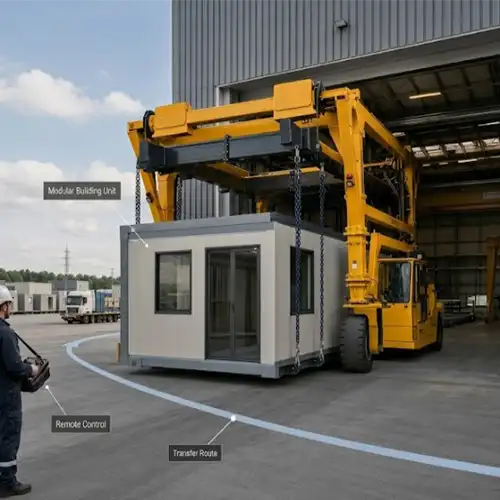
Industrial Rubber-Tyred Straddle Carriers & Straddle Cranes
Heavy-duty rubber tyred straddle carrier cranes for containers, steels, concrete components & industrial material handling with flexible outdoor operation.
| Crane Type | Heavy duty rubber tyred straddle carrier |
| Crane Capacity | 10 ton to 100 Ton |
| Application | Material handling, lifting, positioning, assembly, maintenance, loading/unloading, |
| Certifications | CE / ISO / SGS / Other third-party inspection |
| Customization | Customized material handling cranes solutions available for indoor, outdoor, hazardous, corrosive, c |
Category: Straddle Carrier
Tags: straddlecrane
Your Trusted Industrial Straddle Carrier Crane Manufacturer & Supplier
Industrial Rubber-Tyred Straddle Carriers, Tailored Straddle Cranes
Industrial Straddle Carriers: The Essential Guide for Buyers Across Industries
Straddle carriers are versatile, high-capacity, multi-directional lifting solutions that are indispensable for efficiently moving heavy, oversized, or irregular industrial loads. They save time, reduce labor, and enhance safety across ports, construction sites, steel plants, shipyards, and industrial facilities.
Key Takeaways for Industrial Buyers
- Straddle carriers offer multi-directional mobility and precise load placement for capacities ranging from 5 to 100 tons, accommodating everything from small battery cabinets to wind turbine towers.
- They outperform forklifts, reach stackers, and fixed cranes in speed, flexibility, and safety, particularly in environments with irregular or oversized loads.
- Selecting the right straddle carrier involves careful evaluation of load type, weight, dimensions, lifting height, aisle clearance, and spreader compatibility.
- Customization options allow buyers to adapt carriers to narrow aisles, low headroom, mixed load types, and specialized industrial applications.
- Straddle carriers enhance overall operational efficiency, reduce the risk of damage to materials, and minimize labor costs.
FAQ: Straddle Carriers and Rubber-Tyred Straddle Cranes
Answers to common questions about rubber-tyred straddle carriers, their applications, and practical considerations for buyers.
Q1: What is a rubber-tyred straddle carrier, and how is it different from other lifting equipment?
A: A rubber-tyred straddle carrier is a mobile lifting machine that moves heavy or irregular loads with precision.
- Unlike forklifts or cranes, it combines hydraulic lifting, adjustable frames, and electronic guidance.
- It allows multi-directional movement for containers, steel beams, modular units, and industrial machinery.
Q2: Which industries commonly use straddle carriers?
A: Straddle carriers are widely used in ports, construction sites, steel plants, shipyards, renewable energy projects, and industrial warehouses.
- Ports rely on them for stacking containers, steel coils, and timber efficiently.
- Construction sites use them for modular buildings and precast panels, while steel plants move beams and trusses safely.
- Renewable energy sites, like wind farms, use them for towers and blades, and industrial facilities transport battery cabinets and heavy presses.
Q3: How do I choose the right straddle carrier for my yard or facility?
A: Select a carrier based on load weight, size, aisle clearance, and the type of objects you move daily.
- Consider maximum stacking height for containers or precast panels.
- Ensure spreaders fit modular units, machinery, or long steel beams.
- Factor in aisle width, yard layout, and multi-directional maneuvering to prevent collisions and improve workflow.
Q4: What practical considerations should buyers keep in mind?
A: Plan for space, load frequency, and equipment safety features before buying a straddle carrier.
- Check aisle widths, ceiling heights, and turning radii for indoor or mixed-use yards.
- Obstacle sensors and electronic guidance improve safety when handling heavy machinery or sensitive components.
- Smooth hydraulic systems reduce the risk of damaging delicate loads like solar panels, battery racks, or precision equipment.
Q5: What customization options are most useful for industrial operations?
A: Straddle carriers can be customized with adjustable frames, reinforced hydraulics, modular attachments, and low-headroom designs.
- Adjustable lifting frames handle oversized or irregular loads, from modular buildings to steel trusses.
- Reinforced hydraulics support high-frequency lifting in ports, steel plants, and shipyards.
- Electronic guidance, obstacle sensors, and multi-directional steering improve safety and precision in tight spaces.
- Modular carriers allow handling multiple types of loads across different sectors, reducing the need for multiple machines.
Q6: Can one straddle carrier handle multiple industrial applications?
A: Yes, a well-customized straddle carrier can manage containers, machinery, steel, precast panels, and renewable energy components all with one machine.
- Modular and multi-purpose designs let buyers switch between tasks without buying additional equipment.
- Features like adjustable frames, spreaders, and low-headroom configurations make it suitable for mixed-use yards and evolving industrial operations.
Straddle Carrier Overview
Everything you need to know about straddle carriers, their applications, and practical guidance for buyers.
What is a Straddle Carrier?
A straddle carrier is a mobile lifting machine designed to move heavy, oversized, or irregular loads efficiently across industrial yards or factory floors. With rubber tires, adjustable lifting frames, and hydraulic systems, it combines strength, precision, and mobility in a way that standard forklifts or cranes cannot match.
These machines are widely used in industries that handle containers, steel structures, precast concrete, modular buildings, heavy machinery, gas tanks, and even wind turbine components. Their versatility comes from combining mechanical strength, hydraulic lifting, and electronic guidance for accurate placement of loads.
Practical Notes for Buyers:
- Load type and size: Evaluate the heaviest or most irregular load in your operation. This ensures the carrier can handle all other items efficiently.
- Yard layout: Narrow aisles or tight corners may require a carrier with adjustable frame width or smaller dimensions.
- Lifting height and reach: Make sure the carrier can stack containers or place modules at the required heights.
- Operational frequency: High-frequency lifting requires a robust hydraulic system and durable electronic controls.
Why Buyers Choose Straddle Carriers:
- Multi-directional mobility allows smooth repositioning without moving the load manually.
- Adjustable lifting frames can accommodate irregular shapes and uneven weights.
- Electronic guidance and sensors improve safety and prevent collisions.
- Reduces labor intensity compared to forklifts or manual handling.
- Flexible enough for ports, construction sites, steel plants, shipyards, and industrial facilities.
Pro Tip: Focus on the combination of capacity, frame adjustability, and steering precision. A carrier built for your heaviest or most irregular load will usually handle smaller loads easily, providing flexibility across multiple applications.
Advantages Over Other Lifting Equipment
Straddle carriers bring a level of flexibility and efficiency that traditional lifting equipment often cannot match. They are designed to move heavy, irregular, or oversized loads with precision while keeping operators and materials safe. Unlike forklifts or fixed cranes, straddle carriers can work in tight spaces, navigate complex yard layouts, and handle multi-point lifting tasks without slowing down operations.
| Equipment | Capacity | Key Limitation | How Straddle Carriers Are Better | Buyer Tip |
|---|---|---|---|---|
| Forklifts | 2–15 tons | Can't lift very tall, heavy, or irregular loads | Handles bigger, taller, or uneven loads Precise placement |
Check aisle width and lifting height before choosing |
| Reach Stackers | 20–50 tons | Less precise for uneven or modular loads | Lifts irregular or heavy items accurately Safer for mixed loads |
Great for stacking, but straddle carriers work better in tight or mixed yards |
| Cranes / RTGs | 30–100 tons | Fixed; slow to move; needs setup | Mobile, flexible, multi-point lifting Moves around yard easily |
Best for frequent movement of heavy items |
| Manual Hoists / Basic Lifting | 1–10 tons | Slow, labor-intensive, unsafe for heavy loads | Reduces labor; faster and safer Precise control |
Only good for small items; carriers replace multiple manual lifts |
| Forklift + Crane Combo | 2–50 tons | Needs multiple machines; complex coordination | One machine handles many load types Multi-directional |
Simplifies workflow and reduces equipment footprint |
Practical Advantages for Buyers:
- Forklifts: Standard forklifts struggle with high or bulky loads and cannot safely lift oversized or irregular items. Straddle carriers, in contrast, can handle large containers, steel beams, or modular units with multi-point lifting and precise placement.
- Reach Stackers: These machines are useful for stacking containers but have limited precision for uneven or heavy loads. Straddle carriers provide accurate control even when handling irregular or heavy industrial components.
- Cranes and Rubber-Tyred Gantry (RTG) Cranes: Fixed cranes require permanent foundations and take time to reposition. Straddle carriers are mobile and can navigate complex yard or production floor layouts, making them faster and more flexible for daily operations.
- Manual Methods and Basic Lifting Systems: Using manual hoists or simple lifting tools is labor-intensive, time-consuming, and risky for heavy industrial items. Straddle carriers reduce labor, speed up handling, and improve safety for operators and materials.
Practical Tip: Before choosing a straddle carrier, map your facility layout and typical load paths. Make sure the carrier's dimensions, lifting capacity, and steering capabilities match your yard or workshop conditions. This ensures smooth operations and avoids costly mistakes in equipment selection.
Industrial Applications and Environments for Straddle Carriers
Explore how straddle carriers are applied across ports, construction sites, steel plants, shipyards, renewable energy, rail depots, and industrial facilities, with practical guidance for buyers.
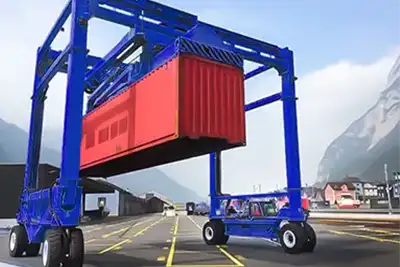
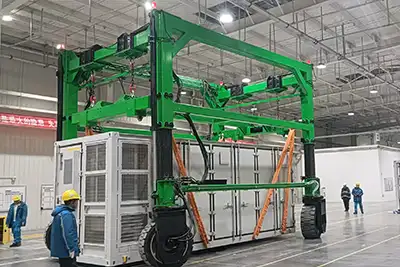
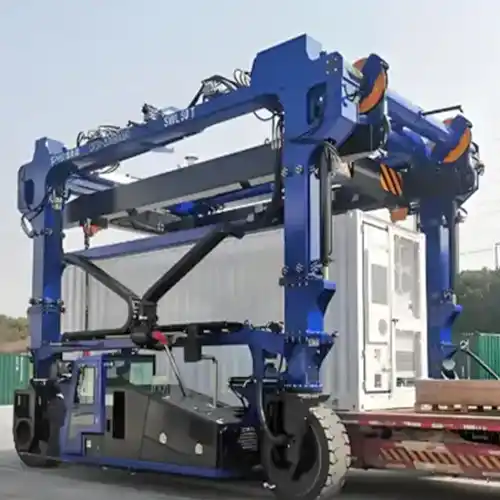
Container straddle carrier- rubber tyed wheel straddle crane for energy storage container handling, 60 ton straddle carrier project for your reference
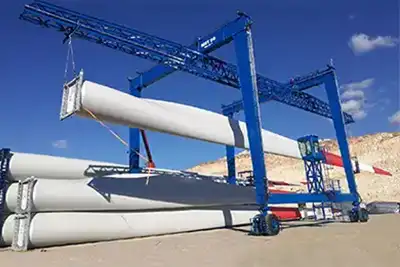
Wind energy industrial straddle crane- Rubber tyred straddle carriers for wind blade handling
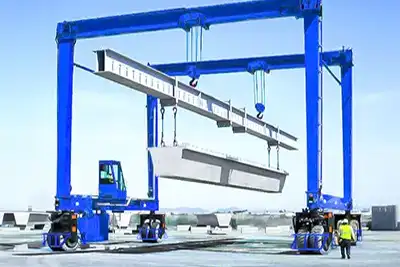
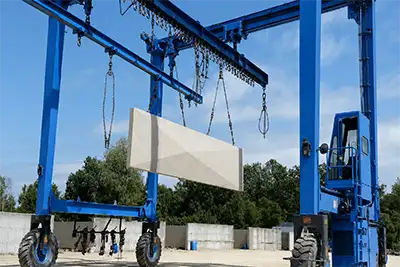
Steel industrial carrier- outdoor straddle cranes for conceret beam handling
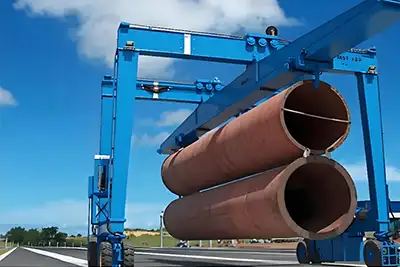
Steel indusstrial carrier crane for large steel pipe handling
Overview of Industrial Applications
Straddle carriers are widely used across industries where heavy, oversized, or irregular loads must be moved safely and efficiently. Their combination of mobility, multi-point lifting, and adjustable frames makes them ideal for yards, production floors, and construction sites. Selecting the right carrier depends on load type, space constraints, and operational frequency.
Straddle carriers are used across a wide range of industries, offering practical solutions for complex lifting challenges:
- Ports and Terminals: Container handling, steel coils, and timber with adjustable spreaders and stacking optimization.
- Construction Sites: Modular buildings and precast components requiring aisle clearance and hydraulic strength.
- Steel Plants: Steel beams, trusses, and fabricated frames with multi-point lifting and durable hydraulics.
- Shipyards: Hull sections, large modules, heavy machinery with long-frame stability and sensors.
- Renewable Energy: Wind turbine towers, blades, and solar arrays needing tall frames and multi-directional steering.
- Rail Depots: Bogies, rails, and wagons requiring long-frame stability and path planning.
- Industrial Facilities: Battery cabinets, gas tanks, heavy presses with adjustable frames and optimized aisle clearance.
Practical Insight for Buyers: Identify the most demanding loads in your facility to select a carrier capable of handling all operations, ensuring flexibility for future projects or changes in industrial workflows.
Ports and Terminals
Ports handle containers, steel coils, timber, and other bulky cargo that must move quickly and safely. Straddle carriers offer precise multi-directional control and high stacking capabilities.
- Typical Capacity: 30–80 tons
- Adjustable spreaders allow handling of standard ISO containers, high-cube containers, or steel coils.
- Multi-directional movement reduces repositioning time in crowded yards.
- Stack height capability optimizes limited space efficiently.
- Practical Tip: Ensure your carrier's spreader can adjust to the tallest stacks you anticipate and check yard pathways for turning radius clearance.
Construction Sites
On construction sites, straddle carriers lift modular buildings, precast panels, and structural components, supporting fast and safe placement.
- Typical Capacity: 20–50 tons
- Hydraulic lifting strength handles heavy precast panels or building modules.
- Multi-point lifting prevents tilting of irregular loads.
- Adequate aisle clearance ensures smooth operation alongside cranes or scaffolding.
- Practical Tip: Measure site entry points and pathway widths before choosing frame dimensions, especially for modular building transport.
Steel Plants
Steel plants frequently move beams, trusses, steel bundles, and fabricated frames. Straddle carriers improve workflow while protecting material integrity.
- Typical Capacity: 30–100 tons
- Multi-point lifting distributes weight evenly for long or irregular steel pieces.
- Heavy-duty hydraulic systems sustain high-frequency operations.
- Precise electronic guidance reduces risk of collision in narrow shop floors.
- Practical Tip: Check if the carrier can handle the longest steel beams in your production, as this determines safe aisle spacing and lifting setup.
Shipyards
Shipyards use straddle carriers for hull sections, large modules, engines, and machinery. Their stability and precision are crucial for assembly and transport.
- Typical Capacity: 40–80 tons
- Long-frame carriers ensure stability for wide or long modules.
- Obstacle sensors reduce collisions in congested dock areas.
- Multi-directional steering allows precise positioning during assembly.
- Practical Tip: Consider carriers with extendable frames for very large modules and check maneuvering space near docks.
Renewable Energy
Wind turbines, solar panels, and other renewable components require careful handling. Straddle carriers safely lift and transport these tall and delicate items.
- Typical Capacity: 40–80 tons (towers/blades) | 5–40 tons (solar panels/HVAC units)
- Tall-frame configurations accommodate turbine towers and blades.
- Adjustable lifting frames prevent damage to sensitive equipment.
- Multi-directional steering ensures safe navigation in outdoor sites.
- Practical Tip: Use carriers with frame height adjustment and obstacle sensors for wind farm assembly or solar array installation.
Rail Depots
Railway depots handle bogies, rails, and wagons that are long, heavy, or awkwardly shaped. Straddle carriers improve handling speed and safety.
- Typical Capacity: 30–80 tons
- Long-frame carriers maintain stability for rails and multiple bogies.
- Path planning reduces handling time and avoids collisions.
- Hydraulic and electronic systems support precise lifting and placement.
- Practical Tip: Ensure aisle paths and yard layout allow smooth turns for long carriers; mark lanes for repeatable handling routes.
Industrial Facilities
Factories and warehouses transport battery cabinets, gas tanks, heavy presses, and industrial pipes. Straddle carriers increase efficiency while reducing labor risks.
- Typical Capacity: 5–80 tons (depending on load)
- Adjustable frames optimize aisle clearance and load footprint.
- Multi-point lifting prevents tilting or load damage.
- Reduces labor intensity and speeds up repeated lifting tasks.
- Practical Tip: For facilities with mixed loads, choose a carrier with flexible frame adjustment and multiple lifting options to avoid needing multiple machines.
Practical Insight for Buyers
Identify the heaviest, largest, or most irregular load in your operation. A straddle carrier capable of handling this will easily manage smaller or standard loads. Factor in yard layout, aisle width, stacking height, and future expansion to ensure your investment remains efficient and safe across all industrial workflows.
Typical Objects Handled by Straddle Carriers and Rubber-Tyred Straddle Cranes
Explore the range of industrial loads that straddle carriers can handle, with practical guidance for buyers on capacity, frame adjustment, and safe handling.
Overview of Typical Loads
Straddle carriers, including rubber-tyred straddle carriers and straddle cranes, are versatile industrial lifting solutions capable of handling a wide variety of heavy, oversized, and irregular loads. Their combination of adjustable lifting frames, hydraulic systems, and multi-directional mobility makes them ideal for factories, ports, shipyards, steel plants, construction sites, and renewable energy projects. Choosing the right carrier requires understanding the type of material, typical capacity, and operational requirements.
Practical Insight: Buyers should evaluate load weight, shape, and handling frequency to determine the appropriate carrier type, lifting frame, and hydraulic configuration.
Containers (Standard, High-Cube, Oversized)
Straddle carriers are essential for container yards and logistics operations, where speed, precision, and stacking ability matter.
- Typical Capacity: 30–80 tons
- Adjustable spreaders allow handling of standard ISO containers, high-cube containers, and oversized units.
- Multi-directional movement ensures fast repositioning even in congested port yards.
- Compatible with straddle cranes for container loading/unloading from trucks and ships.
- Practical Tip: Confirm maximum stacking height and turning radius in your yard to select a carrier with appropriate spreader flexibility and maneuverability.
Modular Buildings (Residential, Commercial, Industrial Units)
Rubber-tyred straddle carriers handle modular construction units safely and efficiently, supporting precise placement at construction sites or storage yards.
- Typical Capacity: 20–50 tons
- Durable hydraulic systems support repeated lifting of large modular panels.
- Adjustable frame width accommodates different unit sizes.
- Supports multi-point lifting to prevent tilting or damage to structures.
- Practical Tip: Measure entry gates, site aisle widths, and lifting heights before transport to avoid bottlenecks.
Steel Structures (Beams, Trusses, Fabricated Frames)
In steel plants and fabrication yards, straddle carriers and straddle cranes are used to move long, heavy steel components safely and precisely.
- Typical Capacity: 30–100 tons
- Multi-point lifting ensures weight distribution over long or irregular structures.
- Heavy-duty hydraulic systems handle high-frequency lifting of beams and trusses.
- Electronic guidance supports precise positioning during assembly or storage.
- Practical Tip: Verify the length and width of your steel pieces against carrier frame dimensions and aisle widths for safe handling.
Precast Concrete Panels (Slabs, Beams, Panels)
Handling precast concrete panels requires smooth and stable lifting to avoid cracking or tilting.
- Typical Capacity: 25–70 tons
- Hydraulic lifting with smooth acceleration protects concrete surfaces.
- Compatible clamps secure panels during transport.
- Rubber-tyred straddle carriers can navigate rough yard surfaces without jolting the load.
- Practical Tip: Measure panel dimensions and weight distribution; choose spreaders and lifting clamps that fit your heaviest and largest pieces.
Heavy Machinery (Engines, Turbines, Industrial Presses)
Heavy machinery requires precise alignment for safe transport and installation.
- Typical Capacity: 30–80 tons
- Spreader alignment prevents load damage.
- Multi-directional steering allows accurate placement in tight industrial spaces.
- Straddle carriers reduce reliance on multiple cranes or forklifts.
- Practical Tip: Plan the machine path carefully and confirm aisle widths for smooth operation.
Gas Tanks and Pressure Vessels
- Typical Capacity: 15–80 tons
- Secure clamps and obstacle sensors improve safety during lifting and transport.
- Hydraulic controls prevent tilting and sudden movement.
- Practical Tip: Ensure the carrier frame can accommodate the height and width of tanks without risking collisions.
Capacity and Selection Considerations for Straddle Carriers and Rubber-Tyred Straddle Cranes
Understand how to select the right straddle carrier for your industrial loads, from 5–100 tons, by evaluating operational environment, load types, and lifting requirements.
Overview
Straddle carriers, including rubber-tyred straddle carriers and straddle cranes, handle industrial loads from 5 to 100 tons depending on the application. Used in ports, container yards, construction sites, steel plants, shipyards, renewable energy projects, and industrial facilities, selection involves more than just maximum weight—it requires understanding load type, yard layout, lifting requirements, and operational environment.
| Load Type | Capacity | Buyer Checklist |
|---|---|---|
| Containers | 30–80 tons | Spreader adjustability; stacking height |
| Modular Units | 20–50 tons | Hydraulic durability; protective spreaders |
| Steel Structures | 30–100 tons | Multi-point lifting; aisle clearance |
| Precast Concrete | 25–70 tons | Clamp compatibility; smooth lift |
| Heavy Machinery | 30–80 tons | Precise spreader footprint; placement |
| Gas Tanks | 15–80 tons | Secure clamps; obstacle detection |
| Battery Cabinets | 5–30 tons | Adjustable frame; aisle width |
| Pipes & Tubes | 20–50 tons | Long-path clearance; spreader flexibility |
| Wind Turbines | 40–80 tons | Steering flexibility; tall frame |
| Steel Coils / Timber / Ship Modules | 10–100 tons | Specialized spreaders; yard layout |
| Solar Panels / HVAC | 5–40 tons | Stable platform; vertical clearance |
| Railway Equipment | 30–80 tons | Long-frame carriers; path planning |
Maximum Load and Dimensions
Knowing the heaviest and largest load in your facility is crucial. Straddle carriers manage everything from containers and modular buildings to wind turbine components and ship modules.
- Typical Capacity Range: 5–100 tons depending on load type
- A carrier handling your largest load ensures smaller loads are managed easily without strain.
- Practical Tip: Identify the maximum width, length, and weight of typical loads to select a carrier with sufficient frame adjustment, spreader compatibility, and multi-point lifting capability.
Spreader and Lifting Frame Compatibility
- Compatibility with steel beams, modular units, precast panels, pipes, and machinery is essential.
- Specialized spreaders are required for long industrial components, steel coils, and wind turbine blades.
- Practical Tip: Consult manufacturers for customized spreader solutions tailored to load shapes and yard workflow. Multi-purpose carriers reduce the need for multiple machines.
Aisle Clearance and Yard Layout
- Narrow lanes, tight corners, and stacking areas must be measured to ensure safe operation.
- Multi-directional steering and electronic guidance systems allow precise positioning, reducing handling time.
- Practical Tip: Map your yard and check for overhead obstructions, low-headroom areas, and congested pathways.
Lifting Height Requirements
- Carriers are available with low-headroom or standard-height lifting frames.
- High stacking applications require extended lifting heights and robust hydraulics.
- Practical Tip: Confirm maximum stack height in your facility to ensure frame and spreader design reach safely without compromising stability.
Hydraulic and Electronic System Durability
- Durable hydraulic pumps, electronic steering, and precise load control reduce downtime.
- Multi-point electronic control improves placement precision for irregular loads.
- Practical Tip: Choose carriers with robust hydraulic circuits and industrial-grade electronic guidance systems.
Operational Flexibility and Multi-Load Handling
- Multi-purpose carriers reduce the need for multiple machines, saving space and labor.
- Supports straddle crane functionality, yard mobility, and multi-point lifting for irregular loads.
- Practical Tip: Evaluate the range of loads regularly handled and choose a carrier with adjustable frames, multi-point spreaders, and modular lifting options.
Key Takeaways for Industrial Buyers
- Straddle carriers range from 5–100 tons and handle diverse industrial loads.
- Evaluate maximum load, dimensions, spreader compatibility, aisle clearance, lifting height, hydraulic durability, and operational flexibility.
- Proper selection ensures safe, efficient, and versatile operation across all industrial facilities.
- Consult manufacturers for custom spreaders, low-headroom frames, and adjustable options for optimized performance.
Straddle carrier for flexible movement and 360 degree steering
straddle carrier for container handling
straddle carrier for steel handling
50 ton straddle carrier
60 ton straddle carrier
80 ton straddle carrier- hydraulic straddle carrier
Customization Options for Straddle Carriers Across Industrial Sectors
Tailor straddle carriers to your industrial operation to improve efficiency, safety, and workflow, whether handling containers, steel beams, precast panels, or renewable energy components.
Overview
No two industrial operations are identical, and straddle carriers must be adapted to sector-specific demands. Customization allows buyers to match the carrier's lifting frame, hydraulic system, and electronic controls to the type of load, frequency of operation, and site environment, ensuring optimal performance across all applications.
Adjustable Lifting Frames for Varied Loads
- Equipped with adjustable lifting frames to handle irregular, oversized, or multi-point loads like modular buildings, precast panels, steel trusses, pipes, and heavy machinery.
- Allows safe placement and transport of long or wide objects without tilting or damage.
- Practical Tip: For steel plants or shipyards with variable load dimensions, select a straddle carrier with modular frame adjustment to efficiently manage both large and small loads.
Hydraulic System Customization
- Heavy-duty hydraulics are essential for high-frequency lifting operations, especially with containers, steel coils, or industrial presses.
- Upgrades can include reinforced cylinders, high-capacity pumps, and precision valves for handling heavier loads or repeated cycles safely.
- Practical Tip: In ports or yards with continuous container handling, choose hydraulics rated for uninterrupted operation to minimize downtime and maintenance.
Electronic Guidance and Safety Systems
- Optional electronic steering, load sensors, obstacle detection, and precise load placement controls.
- Essential in narrow aisles, congested warehouses, or outdoor yards for safe movement of containers, machinery, or renewable energy components.
- Practical Tip: Use obstacle detection for loads like gas tanks, battery cabinets, or wind turbine components to prevent damage or safety risks.
Low-Headroom and Narrow-Aisle Configurations
- Customizable low-headroom frames for indoor facilities, warehouses, or plants with limited ceiling height.
- Narrow-aisle options enable safe maneuvering without expanding floor space.
- Practical Tip: Measure overhead beams, doors, and aisle widths before selecting a low-headroom carrier for modular units, battery cabinets, or precast panels.
Modular and Multi-Purpose Straddle Carriers
- Modular carriers adapt to multiple industrial sectors and various loads, including containers, steel beams, precast panels, and renewable energy equipment.
- Future-proof designs allow upgrades or frame modifications as operations evolve or new loads are introduced.
- Practical Tip: For mixed-load facilities, choose a modular carrier with adjustable frames, customizable spreaders, and multi-point lifting capability to reduce reliance on additional machines.
Industry-Specific Customizations
- Ports & Container Yards: Adjustable spreaders, reinforced hydraulics, electronic steering for tight yard navigation.
- Construction Sites: Low-headroom frames, smooth hydraulic lift, multi-point lifting for modular units.
- Steel Plants & Fabrication Yards: Heavy-duty hydraulics, long-frame carriers for steel beams, adjustable lifting frames for oversized structures.
- Shipyards: Extended frames for hull modules, obstacle sensors, modular lifting attachments.
- Renewable Energy Projects: Tall-frame carriers for wind towers, multi-directional steering for blades/nacelles, adjustable spreaders for solar arrays/battery units.
- Industrial Facilities: Narrow-aisle carriers for battery cabinets, adjustable frames for gas tanks/machinery, smooth hydraulic lifting for sensitive equipment.
Customized Straddle Carrier Options for Different Industrial Sectors
Tailor straddle carriers and rubber-tyred straddle cranes to your industrial sector for safe, precise, and efficient load handling across containers, modular units, steel structures, precast concrete, machinery, and renewable energy components.
Ports and Container Yards
- Customized Options: Adjustable spreaders for standard 20–40ft containers, high-cube, and oversized units. Reinforced hydraulics for continuous stacking. Electronic steering and obstacle detection for tight yard navigation.
- Typical Capacity: 30–80 tons
- Practical Tip: Use carriers with quick-spreader adjustment and electronic guidance to reduce handling time and improve stacking accuracy.
Construction Sites
- Customized Options: Low-headroom frames for indoor areas. Smooth hydraulic lifts for precast panels. Multi-point lifting frames for modular units to maintain balance during transport.
- Typical Capacity: 20–50 tons for modular units, 25–70 tons for precast panels
- Practical Tip: Measure aisle widths and door clearances. Adjustable frames and compact turning radii are essential for safe on-site movement.
Steel Plants and Fabrication Yards
- Customized Options: Long-frame carriers for stability with long steel components. Heavy-duty hydraulic upgrades. Adjustable lifting frames for oversized or irregular structures.
- Typical Capacity: 30–100 tons
- Practical Tip: Check the longest steel pieces and heaviest beams to ensure safe lifting. Electronic guidance aids precise placement and reduces damage risk.
Shipyards
- Customized Options: Extended-frame carriers for hull sections and large modules. Modular lifting attachments for engines, machinery, and auxiliary components. Obstacle sensors and precision steering for safe navigation.
- Typical Capacity: 40–100 tons
- Practical Tip: Map yard paths and deck clearances. Modular attachments allow one carrier to handle multiple ship components efficiently.
Renewable Energy Projects
- Customized Options: Tall-frame carriers for wind towers and nacelles. Multi-directional steering for complex layouts. Adjustable spreaders for solar panels, battery racks, and turbine components.
- Typical Capacity: 40–80 tons for towers/blades, 5–40 tons for solar panels or battery units
- Practical Tip: Ensure vertical clearance at storage and installation sites. Use multi-point lifting and hydraulic precision to reduce risk of damage.
Industrial Facilities and Warehouses
- Customized Options: Narrow-aisle carriers for tight layouts. Adjustable frames for varied load sizes. Smooth hydraulic lifting to protect sensitive equipment and prevent collisions.
- Typical Capacity: 5–50 tons depending on load type
- Practical Tip: Measure aisle width, floor strength, and ceiling height to select a carrier that moves safely and efficiently across mixed-load operations.
Summary Insight
Customizing a straddle carrier or rubber-tyred straddle crane ensures safe and efficient handling of containers, steel structures, precast panels, modular units, machinery, and renewable energy components. Features like adjustable frames, reinforced hydraulics, modular attachments, electronic guidance, and low-headroom options enable one carrier to perform multiple tasks, reducing operational costs and improving workflow efficiency across industrial sectors.
Contact Us to Get Tailored Straddle Carrier
Rubber-tyred straddle carriers are practical, versatile, and essential industrial lifting solutions. They provide multi-directional mobility, high capacity, and precise placement for a variety of loads across ports, construction sites, steel plants, shipyards, renewable energy projects, rail depots, and industrial facilities.
Taking the load types, yard layout, capacity requirements, and customization options, buyers can improve safety, efficiency, and return on investment. Well-chosen straddle carriers save time, reduce labor, prevent material damage, and outperform forklifts, reach stackers, and traditional cranes in demanding industrial environments.
Send Us an Inquiry on Rubber-Tyred Straddle Carriers & Straddle Cranes Tailored for Your Industrial Needs.
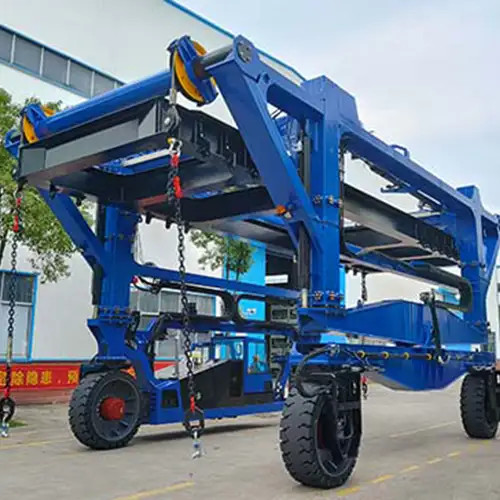
Latest project
150 Ton Overhead Crane Installation Feedback – Paraguay Case
QDX 150 ton overhead crane in action in Paraguay. Installation photos, video, and client feedback show performance, safety, and heavy-lifting efficiency.
Free consultation to Confirm Parameters & Specifications and Get
Latest Crane Price & Crane Rate.
- Types of overhead cranes : _______?
- Optional: Overhead travelling crane, goliath gantry crane,Slewing jib crane, Single girder or double girder crane,small portable crane or kbk crane, etc.
- Capacity of overhead crane: _______?
- Optional: 0.25ton, 0.5 ton, 1 ton, 2 ton, 3ton, 5 ton, 10 ton,15ton, 20ton, 25 ton, 30ton,35ton, up to 550ton, etc.
- Crane span & lifting height : _______?
- Crane travelling length : _____?
- Control of overhead crane:_______?
- Optional: pendant/ remote/cabin control
- Voltage supply of overhead crane:_____?
- Eg,: 380V50/60HZ,3Phase or others,etc.
- Application/usage of crane:_______?
- Eg,: Steel mill, ,injection mold, cement,stone, concrete,granite, general manufacturing, etc.
Just leave a message via the contact form and our hoist and crane engineer will contact you with in 24working hours.
Get In Touch